
A nylon part can pass inspection shortly after molding, then fit differently after storage in humid air or service in water. The drawing has not changed, but the material's moisture content has. Polyamide absorbs water into the polymer; the resulting change in chain mobility and spacing can alter dimensions as well as stiffness and impact behavior. The size change depends on the exact grade, reinforcement, geometry, humidity, temperature, and time. It cannot be assigned one universal “nylon expansion percentage.”
This article explains the mechanism and gives a practical way to measure it. It addresses post-molding moisture exposure, which is distinct from drying pellets before injection molding.
What actually happens when nylon absorbs moisture?
PA6 and PA66 contain amide groups that interact with water. As water enters the polymer, it changes intermolecular interactions and acts as a plasticizer. Under ordinary conditioning, a part may become less stiff and more ductile while its dimensions increase. Absorption also takes time: a thin surface layer can be wetter than the core before the moisture distribution evens out. The rate and equilibrium level depend on exposure conditions and wall thickness. BASF's Ultramid technical brochure documents changes in dimensions and mechanical properties across its own PA grades.
Moisture swelling and hydrolysis are different failure mechanisms. Ordinary moisture conditioning changes the physical state and can be partly reversed by drying under appropriate conditions. Prolonged exposure to hot water or aggressive media can also cause chemical degradation; drying does not repair broken polymer chains. Temperature, liquid composition, load, and duration determine whether that risk matters. A part that grows slightly but remains strong needs a different response from one that embrittles or loses strength. See our water-treatment nylon selection guide for application-specific material questions. BASF discusses the effect of water on stiffness and strength in its chemical-resistance guidance.
Why can the dimensional change be hard to predict?
The state at which the drawing dimension is checked matters. “As molded,” “dry,” “conditioned at a specified atmosphere,” and “after water immersion” describe different material states. A water-immersion result should not be substituted for a part that spends its life in moderately humid air. Likewise, a laboratory bar may not represent a thick, ribbed part with local stress and several wall sections.
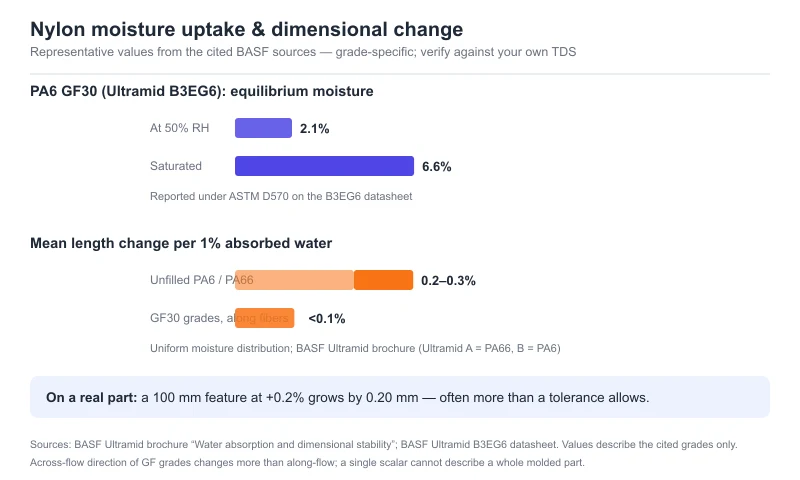
BASF reports that, for its unreinforced Ultramid A and B grades under uniform moisture distribution, the mean length increase is about 0.2–0.3% per 1% absorbed water. The same brochure states that, for its glass-fiber-reinforced grades, the length change along the fiber orientation is less than 0.1% per 1% absorbed water. These are published examples for those materials and conditions, not tolerances or design coefficients for Jinsu grades. The across-fiber direction and a real part's fiber pattern must be measured separately. BASF Ultramid brochure, “Water absorption and dimensional stability”
For a 100 mm feature, a 0.2% change would be 0.20 mm. This is arithmetic illustrating why a small percentage matters at assembly scale; it is not a predicted change for your part. Thread fit, sealing faces, bearing seats, and snap engagement can all be sensitive to changes smaller than a millimeter.
Does 30% glass fiber solve the problem?
Glass fiber generally restrains dimensional change in the direction the fibers align. It can also make dimensional response directional. In an injection-molded part, fiber orientation is affected by the gate, flow path, wall thickness, and weld lines. A single scalar “moisture expansion” value therefore cannot describe every feature of a PA6 GF30 or PA66 GF30 component.
Reinforcement also does not make the polyamide matrix immune to water. For example, BASF's separate Ultramid B3EG6 datasheet identifies that material as a 30% glass-fiber-reinforced PA6 grade and lists moisture values of 2.1% at 50% relative humidity and 6.6% at saturation, under its stated ASTM D570 reporting. Those figures describe that specific BASF grade, not all PA6 GF30 compounds. They show why service humidity and test condition belong next to every moisture number. BASF B3EG6 datasheet
If a glass-filled part warps while stored, check moisture and fiber orientation, molded-in stress, and nonuniform wall sections. A directional dimensional shift may be caused by several effects together; the change should not be attributed to absorption alone without measurements.
Mold shrinkage, thermal expansion, and moisture swelling are not the same number
Mold shrinkage describes the dimensional difference created during molding and cooling under specified test conditions. Thermal expansion concerns temperature change. Moisture swelling concerns water uptake after molding. Creep under sustained load and chemical degradation can add further changes. A datasheet's mold-shrinkage range is therefore not an answer to “How much will this finished part grow in a humid warehouse?”
When evaluating a leak or an assembly failure, record the part's dimensions, mass, temperature, humidity, age, and load history. Measuring a failed wet part against the drawing alone may hide the point at which the drift occurred.
A practical test plan for a tolerance-critical nylon part
- Define the service envelope. Record operating and storage temperature, relative humidity or liquid contact, exposure time, load, and the critical fit or seal. Decide whether the part will be inspected dry, conditioned, or after service exposure.
- Identify the exact compound. Obtain the current TDS and ask whether reported properties are dry, conditioned, or immersed. Record polymer type, glass-fiber content, other fillers, color, and any stabilization package. The same “PA66 GF30” label can cover different formulations.
- Set a repeatable initial state. Record the production batch, molding settings, conditioning history, mass, and critical dimensions. Use the same measurement locations and instrument for every time point.
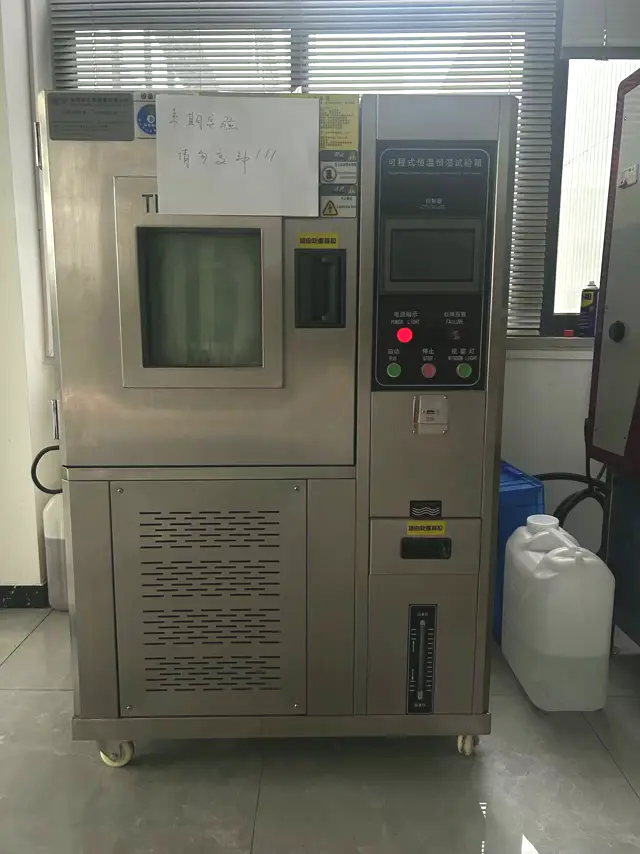
- Condition both specimens and real parts. Include a controlled humid-air condition relevant to use and a water or medium exposure only if the application needs it. Document temperature, humidity or liquid, specimen thickness, and time. ISO 62:2008 describes water-absorption methods for defined plastic specimens in water or humid air; ISO 291:2008 addresses controlled atmospheres for conditioning and testing.
- Measure mass and dimensions over time. Record length, width, thickness, and functional features separately. Check both along-flow and across-flow directions for a glass-filled part. Stop the test when the application-defined duration or agreed stabilization criterion is reached; do not assume 24 hours represents equilibrium.
- Check function, not just the caliper. Test assembly force, torque, leak rate, electrical clearance, or another feature that actually determines part acceptance. If exposure is hot, prolonged, or chemically aggressive, assess strength retention as well as size.
For moisture uptake relative to the defined initial dry mass, calculate mass gain (%) = (mass after exposure − initial dry mass) ÷ initial dry mass × 100. For a particular feature, calculate dimensional change (%) = (dimension after exposure − initial dimension) ÷ initial dimension × 100. Keep the initial state and exposure condition beside each result. If the part is not initially dry, label the calculation as change from that starting state rather than “water absorption.”
ISO 15512:2019 covers determination of water content in plastics, including granules and finished articles; it explicitly distinguishes this from the absorption behavior measured under ISO 62. A result for one does not replace the other.
How should material selection change?
First decide how much dimensional drift the assembly can tolerate over its service life. Then compare specific compounds under the same moisture state and test conditions. Options may include a reinforced PA6 or PA66 grade, a formulation selected for water exposure, or another polyamide with a different moisture profile. None should be approved solely because a polymer family is described as “low absorption.”
When the concern is hot-water durability, verify the actual grade's aging and property-retention data. A “hydrolysis-resistant” description does not automatically guarantee low moisture swelling, and lower swelling does not by itself establish long-term hydrolysis resistance. For a water-contact part, check each requirement independently.
If you are choosing between nylon grades for a tight-tolerance part, review our PA6 and PA66 materials or send us the drawing, tolerance, and service conditions. We can recommend candidate grades and a sample test plan; the final choice should be validated in your part and process.
Frequently asked questions
Will drying nylon pellets prevent a finished part from growing later?
No. Pellet drying addresses moisture before molding. Once molded, the part can take up moisture from its environment until it approaches a condition-dependent state. Both processing moisture and service moisture should be controlled, but at different stages.
Is water absorption always permanent?
Ordinary moisture uptake is a physical process and can be partly reversible. A change in mass or dimensions alone does not prove permanent damage. Repeated hot-water exposure, aggressive chemicals, or sustained stress can introduce additional, potentially irreversible changes; test for those separately.
Can I use a supplier's “24-hour water absorption” number as my dimensional tolerance?
No. Absorbed-water mass percentage and length change percentage are different measurements. A 24-hour test also may not reflect equilibrium or the actual wall thickness and service conditions of your part.
Do PA6 GF30 and PA66 GF30 have the same moisture behavior?
Not necessarily. Resin chemistry, grade formulation, fiber amount and orientation, and exposure conditions all matter. Compare the exact supplier grades in the dry and conditioned states that match your application.