
How to Choose a Plastic Pellet Supplier: 7 Criteria
How can importers avoid low-price traps and quality failures when buying plastic pellets? Seven criteria: ISO certification, TDS consistency, batch stability, MOQ flexibility, Indonesia logistics experience, payment terms and sample policy — plus a red-flag checklist and a step-by-step verification path.
For Indonesian importers, finding a cheap plastic pellet supplier is easy — finding one that can deliver stable quality for three consecutive years is hard. The failure stories follow the same script: perfect samples, inconsistent mass production; a great price, then endless delays; a quality problem, then silence. This guide distills seven verifiable selection criteria, a red-flag checklist, and a complete validation path from first sample to annual partnership — so you can filter out risk before placing the order, instead of discovering it when the container arrives at the port.
Jinsu has not completed UL Yellow Card certification. TDS data and UL94 test results do not constitute UL recognition. If your project requires a Yellow Card, verify certification for the exact grade before approval or purchase.
Next step: from material choice to inquiry
Move from application guidance to a grade, a formulation, and a clear quote request.
The Four Mistakes Importers Make Most Often
1. Ranking suppliers by price alone. The lowest price usually signals recycled content, downgraded grades, or Incoterms traps. By the time black specks, brittle parts or color drift appear in your injection shop, the losses have long exceeded the savings.
2. Placing a large order right after sample approval. Samples can be specially made; mass production shows the real level. Skipping a trial container and going straight to full-volume purchasing is betting all the risk on one hand.
3. Not verifying documents. Certificates can be forged and test reports expire. Unless you check with the issuing body, a certificate is just paper.
4. Ignoring logistics experience. A supplier unfamiliar with Indonesian customs (SNI requirements, import permits) will leave your container sitting at Tanjung Priok for extra weeks — with the demurrage on your account.
Criterion 1: Verifiable Quality Certifications (ISO 9001 & SGS)
ISO 9001 is the baseline threshold — it means the supplier runs a documented quality management system, and batch-to-batch variation risk is significantly lower than at uncertified mills. How to verify: ask for the certificate number, check its validity on the certifying body's website or a third-party registry, and confirm the certificate scope actually covers plastic compounding or production.
Third-party reports from bodies such as SGS validate product-level compliance (RoHS, REACH and similar). Request reports issued within the last six months, and confirm that the product model on the report matches the grade you are buying.
Jinsu, for instance, is ISO 9001 certified, operates 14 twin-screw extrusion lines with monthly capacity above 3,000 tons, and ships every lot with its COA test report. Certifications are not decoration — they are your first filter.
Criterion 2: A TDS That Matches Real Measurements
The Technical Data Sheet (TDS) is the supplier's own promise about the product. Reliable suppliers provide a complete TDS covering melt flow index (MFI), tensile strength, flexural modulus, impact strength and heat deflection temperature at minimum.
How to verify: after receiving the sample, run the key properties on your own injection machine or through a third-party lab, and compare against the TDS. Reasonable tolerance is acceptable (for example, MFI within ±10%), but deviations beyond 20%, or missing key properties, mean the datasheet cannot be trusted.
Also check the details of the document itself: a real factory TDS carries an exact grade name, test standards (ISO or ASTM) and a revision date. A one-page marketing flyer presented as a "TDS" is a red flag.
Criterion 3: Batch-to-Batch Stability and Lot-Level Reports
Plastic processing is continuous production, and batch variation is an injection plant's nightmare: this container processes perfectly, the next one arrives with a different shrinkage behavior, and every mold parameter must be reset.
To assess batch stability, ask the supplier for three things:
- COA reports for three consecutive lots of the same grade — compare whether MFI, density and other key values stay flat - The retention-sample policy: professional factories keep archived samples and records for every lot, enabling full traceability - The changeover and purging procedure: how the twin-screw lines are cleaned between colors and grades directly determines cross-contamination risk
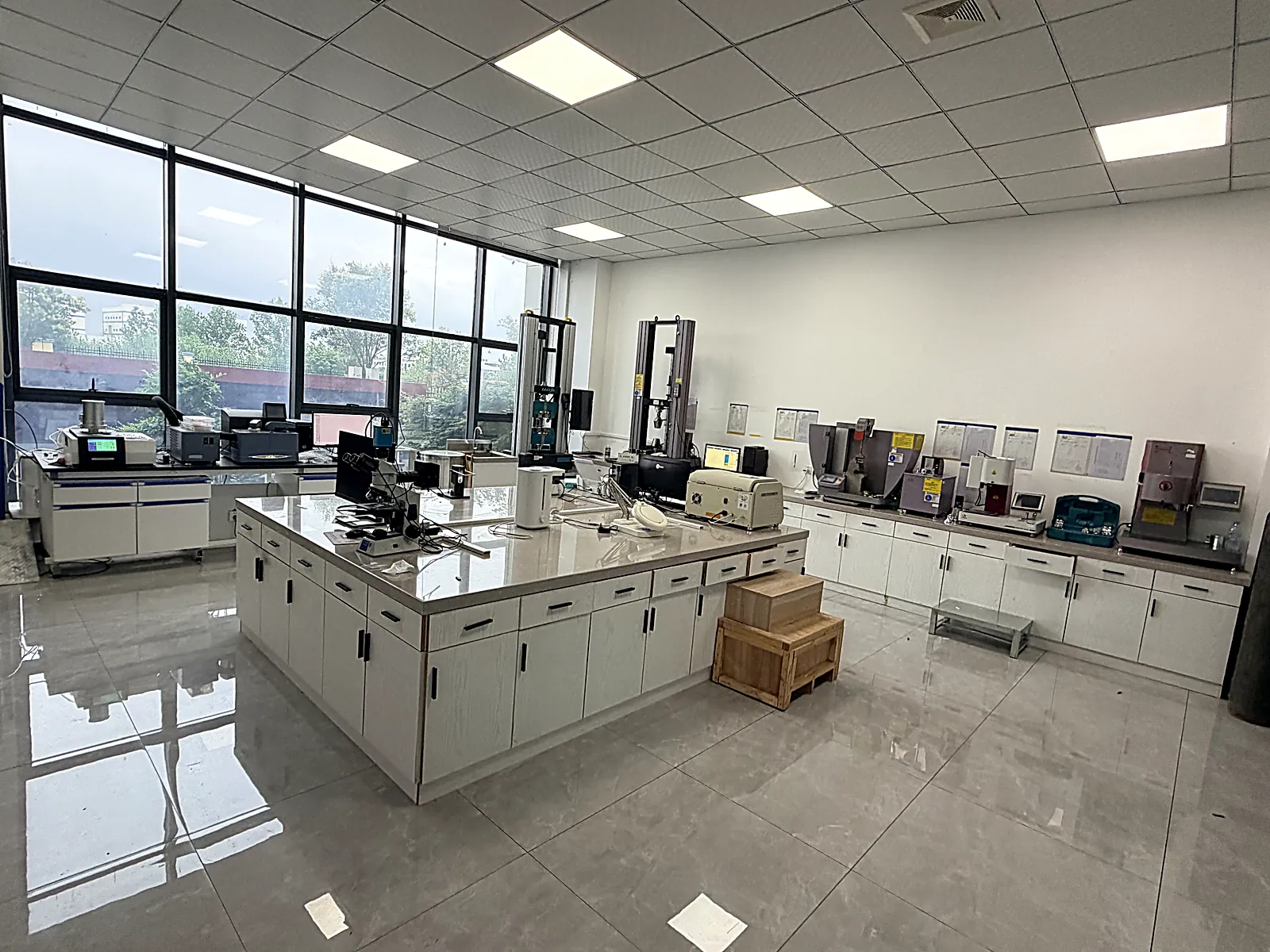
A supplier with its own laboratory (melt flow indexer, tensile tester, impact tester) controls batches far better than a pure trading company.
Criterion 4: MOQ Flexibility That Grows with You
The MOQ (minimum order quantity) reveals the supplier's attitude toward partnership. A supplier that only accepts full-container orders has no interest in your pilot phase; one whose MOQ goes down to 25 kg levels is willing to walk the whole path with you: sample, mold trial, small series, full container.
A sensible growth path looks like this:
- Free samples of 5-10 kg: validate properties and processability - 25 kg to 500 kg: mold tuning and pilot production - LCL up to FCL: drive cost down with full containers once volumes are proven - Annual contract: stable monthly supply plus price protection
The pricing, lead time and documentation standard at every stage should be confirmed in writing beforehand. A supplier willing to set the MOQ at 25 kg — as Jinsu does — is essentially lowering the entry barrier so that your validation cost stays under control.
Criterion 5: Logistics Experience to Jakarta and Surabaya
For plastic pellet imports into Indonesia, logistics problems often cost more than product problems. When evaluating a supplier, confirm:
- A stable shipment record to Jakarta (Tanjung Priok) and Surabaya (Tanjung Perak) — ask for sample bills of lading with customer details redacted
- Familiarity with Indonesian import requirements: the correct HS code for the grade, import licensing procedures, and which categories require mandatory SNI certification
- Seaworthy packing standards: 25 kg moisture-barrier bags on wrapped pallets with container desiccants. Nylon-family materials are moisture-sensitive, and poor packing can push an entire container over the moisture limit
- The ability to quote CIF or DDP terms, shifting customs complexity to the experienced party
Suppliers with real Indonesia market experience will proactively ask about your destination port and import qualifications already at the inquiry stage — that behavior alone is a professionalism signal.
Criterion 6: Payment Terms That Protect Both Sides
Payment terms are trust, quantified. Common structures in the Chinese compounding industry:
- First order with a new customer: 30% deposit plus 70% against the copy of the bill of lading (T/T) — the industry mainstream, with balanced risk on both sides - High-value orders: letter of credit (L/C at sight), suitable when the first order is large or corporate compliance demands it - Established relationships: more flexible terms such as O/A can be negotiated over time
Red flags: demanding 100% prepayment while refusing any shipment-document verification; or the opposite — vagueness about payment mechanics and rushing past contract details. A professional supplier writes payment terms, lead time and liability clauses clearly into the proforma invoice (PI) and the contract.
Criterion 7: A Serious Sample Policy
The sample policy is the most direct expression of a supplier's sincerity. A strong sample policy typically includes:
- Free samples of 5-10 kg — enough for one complete mold trial - A clear sample lead time (standard grades dispatched within 3-7 days) - Samples produced on the same line with the same process as mass production, not hand-picked specials - TDS and COA accompanying the sample, with data matching the exact lot - Proactive follow-up on trial results, including processing-parameter advice
Suppliers that refuse to send samples, charge high sample fees without committing to offset them against orders, or go silent after shipping can be ruled out.
Red Flag Checklist: Any One of These Deserves Caution
- Quotes more than 20% below the market reference range: below-cost pricing can only be recovered through adulteration, downgrading or surprise surcharges later - Inability to provide a TDS, or a datasheet with no grade name and no test standards - Refusal to share third-party test reports from the last six months - Certificate numbers that cannot be verified with the issuing body - Refusal to send samples, or sample fees that are absurdly high - A sales contact who never asks about your application, molds or volumes — a supplier uninterested in your business is interested only in your deposit - Abnormal payment demands: 100% prepayment, personal bank accounts - No fixed factory address and refusal of video factory audits
When you see these signs, do not argue — move to the next supplier. Indonesia's sourcing options are plentiful, and no discount justifies risk you cannot verify.
Verification Roadmap: From First Sample to Annual Partnership
Split the risk into four steps, each with its own pass criteria:
Step 1 — Sample validation (1-2 weeks): request free samples of 5-10 kg, measure MFI and key mechanical properties, and compare against the TDS. Pass criterion: measured values within reasonable tolerance of the datasheet.
Step 2 — Mold trial (2-3 weeks): run 25 kg or more on your actual mold to validate the processing window, shrinkage and surface quality. Pass criterion: stable continuous production with an acceptable yield.
Step 3 — Trial order (1-2 months): place a formal LCL or small-container order to verify that mass production matches the sample, and that lead time and documents are accurate. Pass criterion: arrival inspection matches the sample, customs clearance is smooth.
Step 4 — Scale-up: full containers plus an annual framework, negotiating price protection and priority allocation.
Most Jinsu customers follow exactly this path: starting with free samples, piloting at the 25 kg MOQ, then moving to monthly containers — with TDS, COA and engineer support at every step.
Conclusion
Choosing a plastic pellet supplier is, in essence, choosing your production stability for the next three years. Screen with the seven criteria — certification, TDS consistency, batch stability, MOQ flexibility, Indonesia logistics experience, payment terms and sample policy — eliminate candidates with the red-flag checklist, then validate step by step along the sample, mold trial, trial order, annual contract path. With an ISO 9001 system, 3,000+ tons of monthly capacity, free samples and service in 12 languages, Jinsu welcomes Indonesian importers to start with step one: a free sample.
Frequently Asked Questions
What is the minimum order quantity for importing plastic pellets from China to Indonesia?+
It depends on the supplier. Most factories require full-container orders, but flexible compounders (such as Jinsu) set the MOQ as low as 25 kg and provide free 5-10 kg samples — enough to complete mold trials before scaling up.
How do I verify that a supplier's ISO certificate is genuine?+
Ask for the certificate number and the certifying body's name, then check it in that body's online registry. Confirm the company name, validity period, and that the scope covers plastic production or compounding. If the supplier cannot provide a verifiable number, rule them out.
If the sample passes, will mass production definitely pass too?+
Not necessarily. Samples can be specially prepared; mass production shows the real level. The correct sequence: after sample approval, run mold trials with 25 kg to 1 ton, validate consistency with an LCL or small-container trial order, and only then scale to full containers.
What is the safest way to pay a Chinese supplier?+
For first orders, 30% deposit plus 70% against the bill-of-lading copy (T/T) is the industry mainstream with balanced risk; for high-value orders use an L/C at sight. Always pay corporate accounts and sign a formal contract.
What support does Jinsu offer Indonesian customers?+
Free 5-10 kg samples, a 25 kg MOQ, COA reports for every lot, TDS and SGS documentation, CIF quotes to Jakarta or Surabaya, and a service team covering 12 languages including Bahasa Indonesia. Monthly capacity exceeds 3,000 tons, with ISO 9001-backed batch stability.
Start Verifying Us with a Free Sample
Test us against every criterion in this guide: free 5-10 kg samples, TDS and COA included, quotes within 4 hours. Let the verification process decide.